 SharifStudy Best way to Study in Malaysia


A Cyber Security Engineer is an important position in information technology, responsible for protecting computer systems and networks against cyber threats.
Designing, implementing, and monitoring security measures to safeguard an organization’s data and infrastructure from unauthorized access, cyber assaults, and other vulnerabilities is part of this profession.
With the increased reliance on digital technology and the ongoing evolution of cyber dangers, the demand for qualified Cyber Security Engineers is continuously expanding.
These experts play an important role not only in preventing data breaches and cybercrimes, but also in assuring compliance with many security standards and laws.
Their experience includes network security, threat analysis, security approaches, and security protocol creation.
Cyber Security Engineers are critical in ensuring the integrity and confidentiality of sensitive information as guardians of digital assets in a world where cyber security is an important priority for businesses across all industries.
Cyber Security program
A Cyber Security program, whether a formal degree program or a professional certification, aims to provide individuals with the information and skills necessary to secure computer systems, networks, and data against cyber threats and attacks.
Network security, ethical hacking, cryptography, risk management, and compliance are typical topics covered in these programs. Students learn how to recognize weaknesses, defend against assaults, and respond to breaches.
They also learn about the legal and ethical issues of data security. Emphasizing both theoretical and practical knowledge
If you want to work as Cyber Security Engineer we suggest to study master of data science program at:
Job Responsibilities
Cyber Security Engineers play a vital role in defending digital assets from cyber threats. They are in the position of developing and implementing security policies and protocols to protect against malware, hacking, and other attacks.
This includes not only protecting computer networks and mobile devices, but also developing software and updating hardware.
Their responsibilities include continually watching for vulnerabilities and security breaches, as well as developing rapid incident response strategies to reduce the damage caused by cyber attacks.
They must also effectively explain security tactics and procedures to ensure that all people of an organization understand their responsibility in ensuring security.
Qualifications and Skills
An excellent educational background is required to become a Cyber Security Engineer, often beginning with a bachelor’s degree in subjects such as cybersecurity, computer science, or information technology.
This fundamental education is essential for understanding network security, system weaknesses, and defense measurements. A master’s degree or certifications such as CISSP and CEH can provide more specialization.
Practical experience can be extremely valuable in this sector, which frequently begins with starting positions such as Security Analyst or Network Administrator. It is also advantageous to participate in cybersecurity competitions and open source security projects.
Technical requirements include ability in programming languages such as Python, C++, or Java, as well as a thorough understanding of operating systems and network security.
Soft skills such as solving problems, using logic, and good communication are vital in a profession where the stakes are high and threats are constant.
How to Become a Cybersecurity Engineer
Becoming a Cybersecurity Engineer requires a diverse strategy. Begin with a basic education in cybersecurity, computer science, or a similar topic, which is frequently supplemented by specialist certifications such as CompTIA Security+, CISSP, or CEH.
Develop a strong technical foundation, including knowledge of network security, threat modeling, and programming languages such as Python and Java.
Practical experience is essential, which is often obtained through internships or entry level IT positions. Networking with colleagues, attending industry conferences, and joining relevant groups are essential for professional development and remaining updated.
Staying up to date with the newest advances in cybersecurity is crucial in this fast expanding sector, thus continuous learning is essential.

Annual Salary
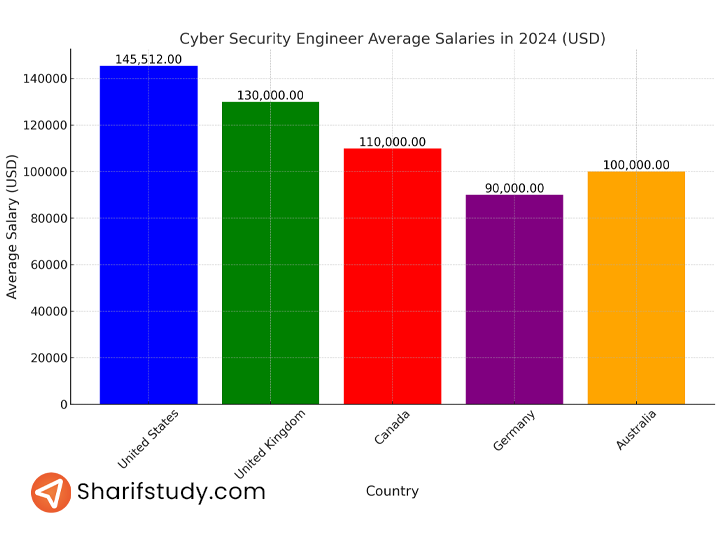
This chart compares the average wages of Cyber Security Engineers in five important countries in 2024. The United States leads the group, with a remarkable mean pay of $145,512, reflecting its strong technology economy and great demand for cybersecurity skills.
The United Kingdom follows closely, with an average of $130,000, suggesting a significant commitment in digital security. Canada offers a competitive pay of $110,000, demonstrating its rising focus on cybersecurity in the technology industry.
Germany and Australia, with average wages of $90,000 and $100,000, respectively, highlight the global importance and profitable nature of cybersecurity professions in today’s technologically driven world.
These numbers demonstrate the various levels of emphasis and resources committed to cybersecurity across countries, emphasizing the field’s vitality and value in today’s digital landscape.
Comparing with Related Career Options
When comparing Cyber Security Engineers to Software Engineers, there are certain similarities.
Software engineers are largely responsible for the development and ongoing support of software, which requires strong engineering, computer science, and mathematical skills. They must be proficient in programming languages and software development technologies.
In terms of compensation, Software Engineers earn between $50,394 and $111,340 per year, which is slightly less than the range for Cyber Security Engineers.
However, the greatest incomes in cybersecurity (such as for a software cyber security architect) can reach $134,254, demonstrating that top professions in cybersecurity may pay more.
Top Countries for IoT Software Developers
Cyber Security Engineers are in high demand globally, with several opportunities available in various nations.
Career opportunities are particularly promising in the United States, where several Fortune 500 organizations are actively recruiting in this profession. Competitive incomes are available in cities such as New York, Texas, and Washington.
However, the cost of living in these areas must also be considered, as it can have a substantial impact on net income.
Countries with a strong IT industry, such as Canada, the United Kingdom, Germany, and Australia, are also viable options for those looking for international prospects.
These countries not only provide competitive pay, but they also actively invest in cybersecurity, reflecting an increasing global emphasis on digital security.
In conclusion the position of a Cyber Security Engineer is both hard and rewarding, requiring a combination of technical skills, practical experience, and continual learning.
With the growing importance of digital security, this career path not only offers excellent wages but also the ability to play a critical part in securing essential digital infrastructures around the world.


